
Before we can talk about the implications of running relentless AI coding agents non-stop, let’s first establish a definition. The easiest way to explain code slop is to start with text. At this point, you’ve probably come across hundreds, if not thousands, of articles, posts, and messages generated by LLMs, and you can easily catch the formulaic sentences weaved into otherwise meaningful information. Transitions like “it is not only X, but also Y” or “whether you are A or B, the solution is Z” are some obvious giveaways. While it’s an interesting research topic on its own, what’s important is that these sentences exist primarily to pad the gaps between disconnected thoughts and manufacture a cohesive message. If you are not in a rush, that might feel harmless.
But who isn’t in a rush these days? Definitely not me.
Text slop is simply low-quality, diluted content created to take up as much space as possible, diluted information, material designed to waste your time. This brings us to our first major point: diluted text imposes a cognitive comprehension toll on the reader, who must work backwards to extract actual information from the noise. The core issue is the massive effort asymmetry: it takes almost zero effort to produce slop, but much greater effort to consume it.
But this is nothing new, the content farms already worked hard for the 19th century newspapers, and during the SEO era of 2010th, broad access to LLMs has widened this gap tremendously over the last few years. As this automated content floods recommendation engines, finding high-value material becomes exhausting. As the result we already experience the “Platform fatigue”, the revival of RSS feeds and curated newsletters, and a 20%+ drop in direct web traffic as users turn to AI summarization tools to bypass the slop altogether.
Software code, however, has one critical distinction from normal text: code translates a evolving set of business requirements into machine code. As feature #N is added, it may potentially impact all previous N-1 features. Depending on the maturity of the codebase, team discipline, and time constraints, this results in one of three scenarios:
- If feature N is entirely independent, complexity grows linearly: O(N).
- If features depend on one another, complexity grows quadratically: O(N2).
- If all features must work in concert, complexity grows exponentially: O(2N).
In the pre-AI world, this complexity creep was held in check by human cognitive limits. And closer to that limit, software engineers had to use modularization, generalizations, and abstractions to keep systems comprehensible.
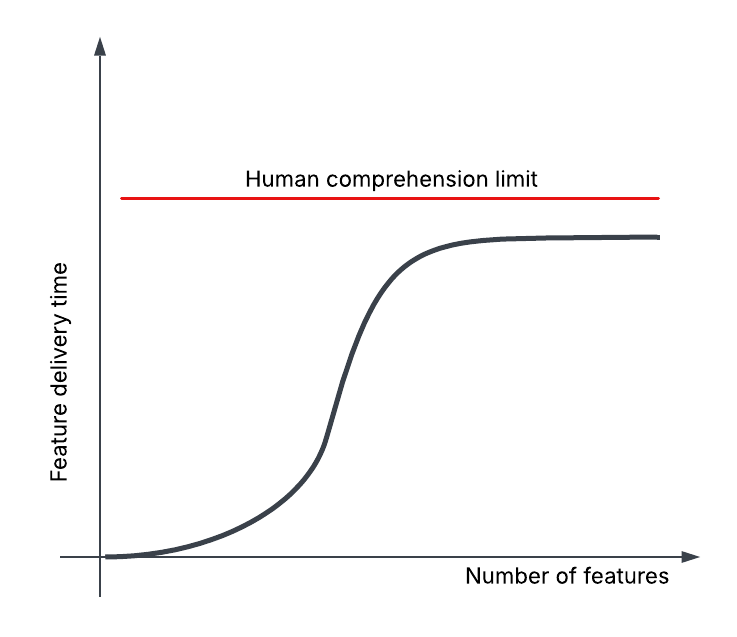
When AI agents are deployed, however, they work in a relentless loop until a feature is built. Without explicit guardrails, an agent implements a feature in the most direct, brute-force way possible, bypassing architectural boundaries entirely. They introduce duplicate code, nested feature flags, and redundant “protective programming” hacks just to get the code to run. When faced with system limitations, AI agents do what humans do when rushed: they work around them. But agents do it endlessly and at lightning speed, turning codebases into unmaintainable spaghetti much faster than any human team could. Because of the sheer volume of output, human reviewers quickly find themselves unable to pay the “comprehension toll” required to audit and catch these structural failures.
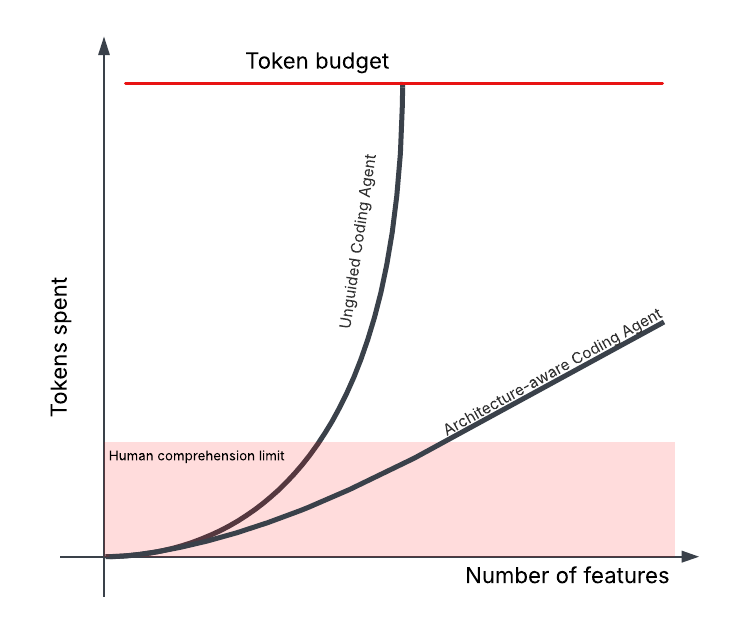
Without proper oversight, guardrails, and specialized tooling, an autonomously built software project can easily drift beyond human comprehension. At that point, the system can only be modified by another AI, which in turn requires an ever-expanding context window, turning that into a runaway cycle: larger context windows require more tokens, driving up API bills in lockstep with the size of the codebase.
Ultimately, the complexity of an AI-generated application isn’t capped by engineering limits; it is capped by the business’s token budget. Slopscape is trying to change that by acting as an automated architectural guardrail, which guides the AI agents towards well-structured, maintainable and comprehensible projects.